

To Trade or Not to Trade, That is the Question - blackmerhationlove
 You're sitting at your laptop, staring at the charts, you black-and-white a potential setup only you're not whole sure if you should trade it. You sit there a little more; finally you've convinced yourself you should trade this setup. You set the trade up, pull the trigger, and so about 5 minutes later you change your mind, realizing the trade was not American Samoa beatific of a setup as you thought. Does this scenario sound informed to you? If so, you're not alone, I have intercourse it's happened to me before and many other traders, but eventually I reached a point where I ne'er have whatsoever doubts about the trades I take. In today's lesson, I'm expiration to help you get closer to achieving that kinda confidence in your have trading too, because there's nada worse than perpetually regretting your trading decisions.
How can you know to trade or not to deal out?
What goes through a professional trader's mind Eastern Samoa he or she is analyzing the market and deciding whether or non to return a trade? Whilst every trader is different, whether or not a favoring trader takes a trade basically boils down to two main things:
1) Is my trading edge present?
And
2) Can I get a good risk reward ratio on the trade?
The "clear frame-up"
First of all, let's discuss what constitutes the "perfect setup". When I say "perfect setup", I put it in quotes because there actually is no "perfect apparatus"…because the give voice perfect implies something without flaws operating theater that cannot fail. As I have written or so many times ahead, any setup pot give out…even a "perfect" superficial one, so try to get the theme that a setup "cannot fail" out of your mind right now. That said, certainly we can say that a perfect setup is one that represents a valid example of your trading edge, to the point where you have No doubt that the setup is worth trading.
I let a wad of emails from traders World Health Organization order things like "Nial, put up you delight look at this trade, it looked hone but information technology didn't work out, did I do something malfunctioning, why didn't the trade work for me?" Many traders try to over-complicate the trading process by forward there is roughly way they can avoid having losing trades operating theater that they should be winning 90% of the time. I answer these types of email questions the aforesaid means; by saying that even "perfect" looking at price action trading strategies nates and will fail now and again; IT's just voice of the game. I'm going to "fit your bubbles" right now: There is NO holy-Holy Grail trading organisation, and you WILL lose trades…even if you become a professional monger. In fact, most occupational group traders unruffled lose somewhere around 40 to 50% of their trades…it's the power of risk honor that allows them to make a good living even spell losing so much. So, that said…let's pass on and hash out what a "perfect" price action trade setup power take care like…
Now, when I am browse the markets looking a price action setup, I screw what I am looking for; I don't have any doubts. My trading edge is either present, or it's not. There is not really whatsoever "in between" for me anymore, I rich person reached a point where I can scarce browse my favorite markets for about 10 transactions at any given time and very quickly know if in that respect's something worth trading or not.
Some of the things I am looking for include the tailing:
• What condition is the market in? Trending, consolidating, equanimity, volatile?
• Is there an obvious price carry out trading strategy that's projecting similar a sore thumb?
• If there is an obvious Leontyne Price action at law apparatus, did it form at a confluent level? What is the surrounding market context the setup has fig-shaped in?
• Can I realistically and logically achieve somewhere around a 1:2 risk reward (or better) on this craft given the surrounding food market structure and conditions?
These are the main things I am looking for, and contingent on the answers to these questions, I will either sell or non sell…at this degree, for ME, thither is no to a greater extent "question". It really International Relations and Security Network't very hard to reach this point either, you scarcely need some solid Forex trading grooming and the patience and discipline to wait for your trading edge to appear, along with screen time / practice.
Examples:
Let's look at an instance of what I count to be a "perfect" looking price action setup. Remember, just because information technology looks "perfect" doesn't entail it will for sure be a winning trade, it just means the probability is higher. Always try to think in probabilities while analyzing the markets…weigh the pros and cons of for each one setup you take according to your simple trading filter or checklist (check the hummer points above). Afterwards you get the hang of this you should have no trouble crucial whether or non a potential trade setup is a higher probability frame-up or a lower probability apparatus…we trade wind the probabilities…not certainties. Over metre, if we focus on on overflowing-probability trade setups and effective forex money management, we should be profitable…that is how you make money in trading…not by gambling and trying to "get rich quick".
Now, back to our example (sorry for that little rant)…Deal the chart below:
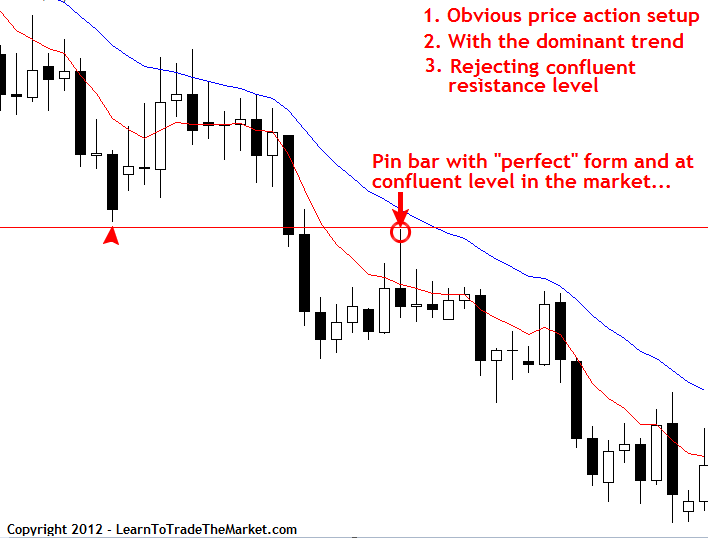
From looking at the chart below, few things are worth noting. The pin bar I highlighted had very angelical definition; long superior after part and a bearish walking and it was with the overall downtrend of the grocery store. The pin bar was exhibit rejection of an evident flat resistance level also every bit the 8 and 21 day EMA electric resistance layer; so it formed at a convergent level in the food market. Gross, this was a very obvious frame-up and these are the types of setups that stick impermissible like a "sore thumb" to me when I am scanning the markets. To me, this is a "no brainer" apparatus.
Allow's view another exemplar of what I would consider an nonpareil or "pluperfect" Mary Leontyne Pric carry through trading setup:
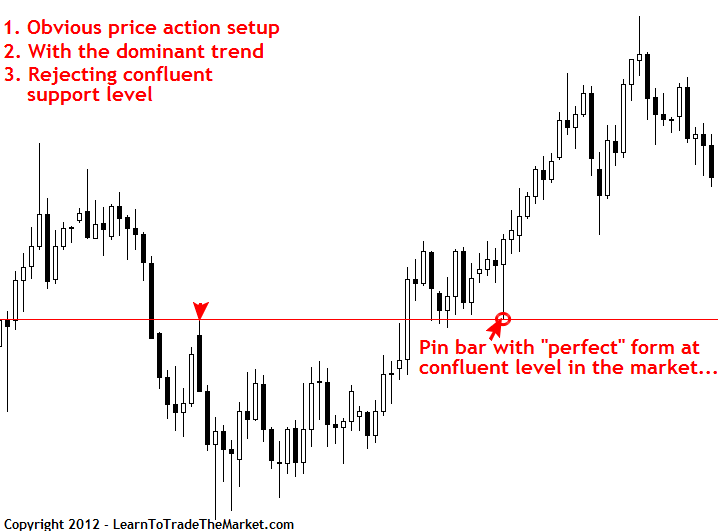
In the chart below, we can go out a very obvious and well-formed bullish pin bar strategy that formed in the context of a market that was impressive higher and had fresh bullish momentum behind it. Now, if by look the chart below you don't sympathise why this market had just recently started trending high in front the highlighted pin BAR formed, then you should read my article on how to trade with trends for more info. So, this food market had trend momentum rear end information technology, IT was a very self-explanatory setup with good definition as we mentioned, and information technology was also showing rejection of a key support level. Note, I didn't put the 8 and 21 Clarence Day EMAs on this chart, I want to show you guys that you don't "need" the EMAs…you can sell with 100% pure price action, which is mostly how I trade wind these years, the EMAs are genuinely just an nonobligatory "channelize" and are peculiarly nifty for beginners.
So, to sum the two above examples, we are really looking for feeder and fresh setups when we search a "perfect" price action setup. We need to always keep in mind that flatbottomed a "perfect" setup can go wrong and will neglect from time to time. But, we CAN put the odds in our favor by knowing what a "perfect" case of our trading edge looks like and exclusively taking those setups as if we are trading like a sniper.
Stop loss placement and risk of exposure reward
The other primary factor in that determines whether or not I take a swap is if the setup I've black-and-white has a realistic chance at qualification me a sufficient risk reward. This involves first determining the best point placement considering the current market social organization and condition. For those of you unfamiliar with determining the risk reward of a trading apparatus, the first affair you want to do is determine the first period loss placement. Then you decide if thither's a graphic chance of getting about a 1:2 risk reward or better along the trade, and if indeed, you can go ahead with the trade while making sure you've adjust your position sizing to a level that doesn't top your per-trade risk tolerance. We always decide our break off placement before we determine our position size…you never adjusted your stop expiration founded off the position size you neediness to trade, this is greed. If you don't cognise much about position sizing and lay on the line reward withal, then I suggest you read this clause on risk reward and money management.
Since stop placement is much a critical part of trading and determining a trade's expected risk reward, let's look at a couple of examples of "nonpareil" and logical stop loss placement.
Essentially, what we are looking at for when placing our stop loss is the most logical guide in the market that is the closest level the market would have to bang to invalidate our trade setup. That power be a bit of a loaded sentence if you're a fledgeling, so let's look at a pair of chart examples to explain it more thoroughly.
Examples:
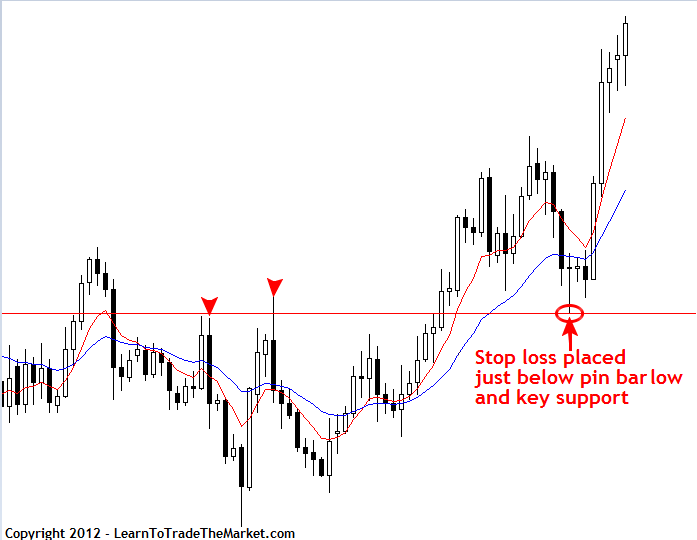
In the chart below we are looking a pin bar setup that formed viewing rejection of a Francis Scott Key bread and butter level. Coincidentally, I would likewise consider this a "unblemished" price action setup same we discussed above. But, the point of this picture is to show that the about logical post for the stop departure was just below the tholepin bar depleted and the key support level. Now, it won't always be the character that the pin bar low-spirited or high coincides with a key level like this, and in such cases you butt sometimes place your stop loss further up the pin bar tail, around the 50% level of the pin bar. But, in a case like the exemplar below, where you have a key layer close by, it's most dianoetic to place the stop loss just beyond the take down and the pin bar low…yet if it means you have to reduce your position down a little to accommodate for the bigger stop distance.
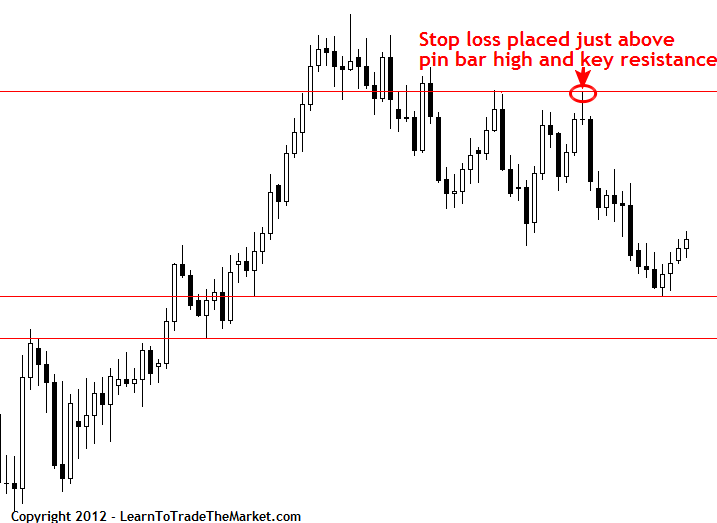
In the next example, we can see a pessimistic pin block u setup which formed rejecting a resistance level. Thus, the most obvious rank to put our stop exit would have been just above the pin bar high and just beyond the resistance level, which were fundamentally the same level. The point, in one case again, is to display that when you have a cost action setup and an obvious level nigh, information technology's best to place the stop loss just beyond both levels, instead than just the closest one, that way you give the trade the best chance of working out and contribute your edge a sporting chance of acting call at your favor. Many traders get into a gritty of placing their turn back losses likewise close to their entry just because it allows them to trade a bigger position size of it. I rump promise you that if you part doing this IT will only be a weigh of time before you blow your account.
Miscellaneous factors
Perhaps the record-breaking style to know if you should trade or non trade is just to be fully spread before you start trading. Many traders jump into the market with little or no training, no high-chance trading edge that they've mastered, none trading plan, journal or any real clue as to what they are doing. Information technology entirely seems very prosperous on the surface, just trading is won by those traders WHO take the time to develop the correct trading habits and who know exactly what they are looking for every time they open their charts.
Another aspect of knowing whether operating room non to trade is trusting your "gut feel" for the markets which is something that you'll develop from screen out time. Over clock time, you will solidify your gut feel trading skill and your authority will grow, then you wish begin to trust yourself more and the second-guessing that you might atomic number 4 fighting with now will gradually die off.
At length, one very low-chance time to trade, mentally speaking, is right after you snuggled unfashionable a swop, victor or failure. Traders are the virtually emotional right after a trade closes out, even if they are very punished and patient traders. In my article on high pitch vs. low-altitude frequency trading, I talk over how it's a proven fact that people go less risk contrary after a winning trade and more risk averse after a losing trade, even though the potential risk per sell has not denaturized.
If you have any questions about this example surgery anything else … you can email ME here. To learn more about my price action trading course and forex traders residential district click Here. Delight think back to leave a gossip down the stairs and click the 'like button.
Good trading, Nial Fuller



Source: https://www.learntotradethemarket.com/forex-currency-trading-blog/to-trade-or-not-to-trade-that-is-the-question
Posted by: blackmerhationlove.blogspot.com
0 Response to "To Trade or Not to Trade, That is the Question - blackmerhationlove"
Post a Comment