

Are Forex And Cfd Contracts Are Over-the-counter (Otc) Derivatives
Over-the-counter, or OTC, refers to anything that is bought and sold directly between seller and buyer, away from a formal securities commutation – the trading is carried out straight either past computer, email, or over the telephone. An over-the-counter stock is one that is non listed on an exchange, such equally a stock market place. OTC derivatives are traded privately and bilaterally – between ii parties – and non on a formal exchange platform.
For the meaning of over-the-counter medications, see the last department of this article.
OTC trading has no physical location – it does non take identify at the New York Stock Exchange, the London Stock Commutation, etc. Over-the-counter trading occurs through a dealer network.
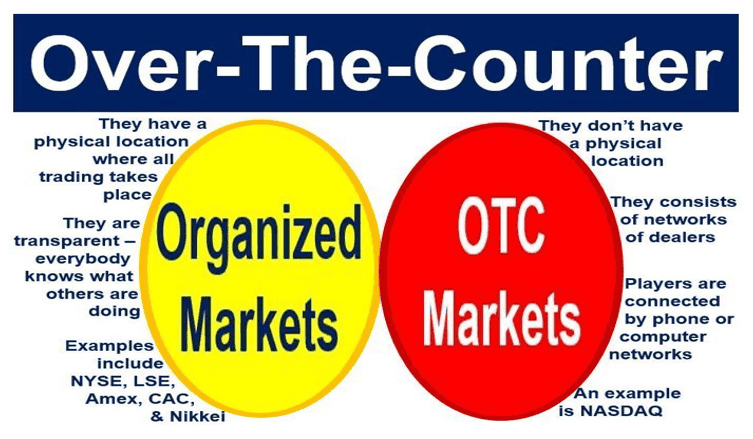
Dissimilar financial instruments traded on stock exchanges, agreements on the features of the financial instrument in an OTC market – what, quantity, price and conditions – are based on mutual consent.
Over-the-counter may also refer to debt securities and a wide range of fiscal instruments that are not traded on a formal exchange but are usually sold by investment banks that seek to heighten funds for item purposes.
In nearly cases, not-prescription medicine financial instruments and products are traded for smaller commercial entities that fail to meet the criteria for listing on the LSE (London Stock Exchange), NYSE (New York Stock Exchange) and other formal platforms. Sometimes they are traded every bit unlisted stock.
Over-the-counter markets – transparency
In an OTC market, trade tin can be carried out between two participants without anybody else existence enlightened of how much coin was involved.
Over-the-counter markets are typically much less transparent than exchanges. Exchanges are subject to considerably more regulations and oversight compared to OTC markets.
When the financial market is stable, OTC markets generally function well. Yet, during times of fiscal stress, every bit occurred during the 2007/8 global credit crisis, their lack of transparency can exacerbate problems.
During the 2007/eight crisis, mortgage-backed securities, which were traded exclusively in the Non-prescription medicine markets, could not exist priced reliably due to a lack of liquidity. Consequently, a big number of dealers withdrew from the market birthday, which made the liquidity problem considerably worse – the global credit crunch was mainly caused by a severe liquidity problem.
Over-the-counter markets
Over-the-counter markets are divided into two main branches:
– Customer Market: dealers trade with institutions and corporations (their clients).
– Interdealer Market: dealers trade with other dealers.
Prices that dealers quote their clients are not always the same as those quoted to other dealers. The bid-ask spread between dealer and client is oft wider than between dealers.
OTC markets are mainly used to merchandise:
- bonds
- derivatives
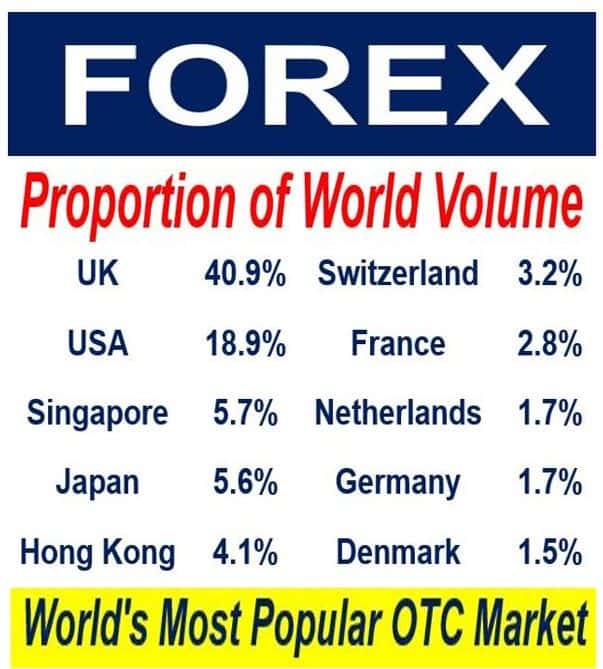
- currencies
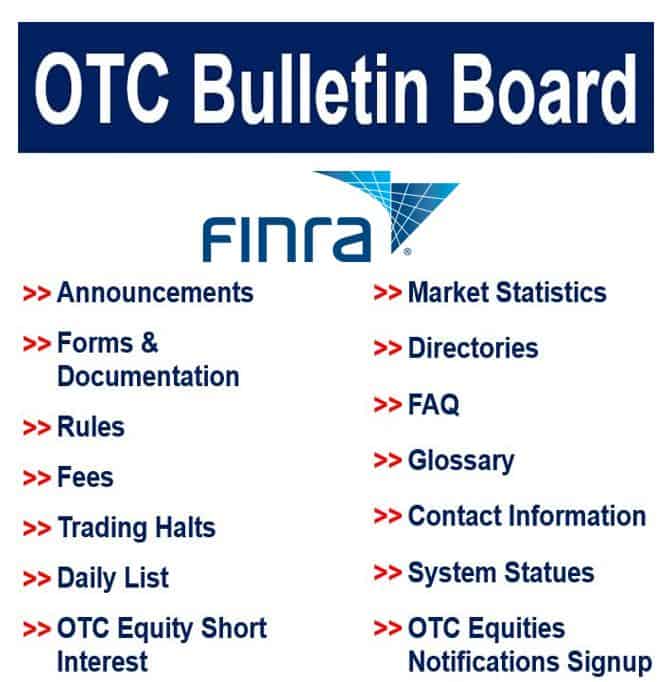
- equities such as the OTC Pink marketplaces, the OTCQB, and the OTCQX (formerly the Pink Sheets and OTC Bulletin Board)
Over-the-counter – drugs
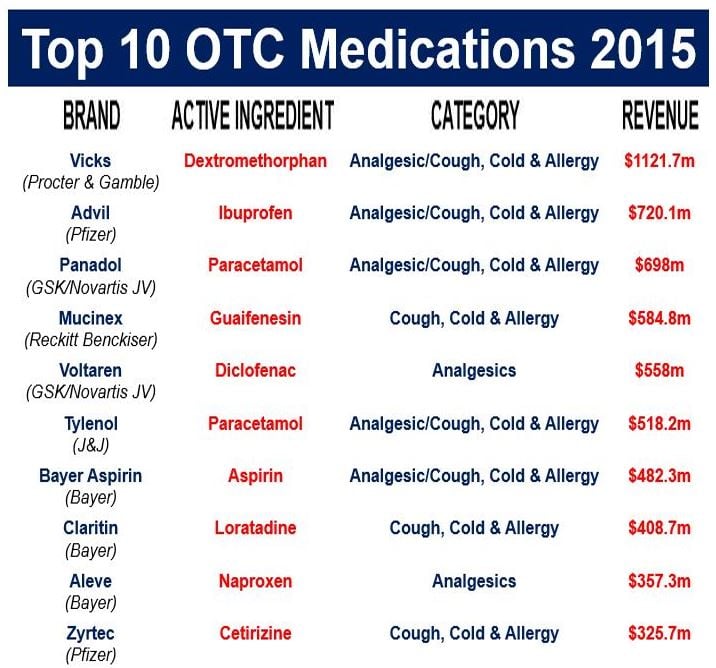
In the world of healthcare, over-the-counter medications, also known every bit nonprescription medicine, are those that can be purchased without needing to present a doctor's prescription or Rx. For example, aspirin, Tylenol (paracetamol), and many cough syrups can be bought straight at a chemist's without having to get-go go to your medico to go a prescription.
The Usa Food & Drug Administration (FDA) has the following definition on its website:
"Over-the-counter medicine is also known every bit OTC or nonprescription medicine. All these terms refer to medicine that you can purchase without a prescription. They are safe and effective when you follow the directions on the label and as directed by your health intendance professional."
According to Mordor Intelligence, the worldwide OTC drugs market was estimated to exist worth $133.25 billion annually at the end of 2016. This figure is expected to reach $220 billion in 2021. During the 2016-to-2021 forecast catamenia, the market is expected have a compound annual growth charge per unit (CAGR) of 10.6%.
In an commodity published in August 2016, Mordor Intelligence wrote:
"A switch by major pharmaceutical companies from Rx to OTC with the objective of investing less and earning more has been instrumental in the growth of the market place in past ten-15 years."
"Companies such as Pfizer, Johnson and Johnson, Sanofi, GSK etc. have increased their focus on OTC drugs development to fetch benefits from this promising market place."
The global OTC market place is segmented into Latin America, N America, the Middle Due east, Asia-Pacific, and Europe. Western Europe and North America make upward almost 42% of the global OTC market, followed past Asia-Pacific with 32%.
The top over-the-counter markets for OTC drugs in 2015 were the United States, French republic, Federal republic of germany, Cathay and Japan – which together accounted for almost 56% of global sales.
However, in the near future these figures are expected to alter. Latin America and Asia-Pacific volition grow it a significantly faster rate than the advanced economies of North America and Western Europe.
Over the next five years, the following markets are expected to grow/contract:
– Mainland china: with the fastest growth in the world.
– Latin America: with the second-fastest growth.
– The Cardinal European will expand more rapidly that the Western European ones.
– North America will probably mail a small refuse – experts predict generic medicines volition boss the market place (92%).
– The Japanese market, which fell by -2% over the past five years, is expected to continue shrinking.
Video explanation

Source: https://marketbusinessnews.com/financial-glossary/counter-otc-definition-meaning/
Posted by: blackmerhationlove.blogspot.com
0 Response to "Are Forex And Cfd Contracts Are Over-the-counter (Otc) Derivatives"
Post a Comment